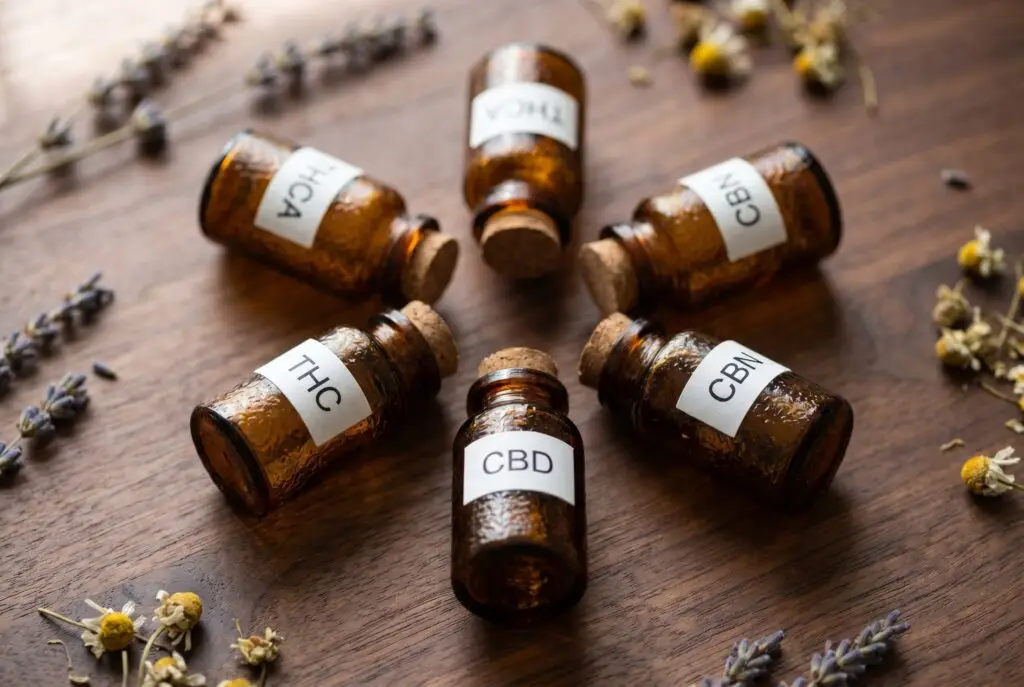
Walk into a Massachusetts dispensary in 2026 and the menu reads like a chemistry textbook. THC, CBD, THCV, CBN, CBG, THCA, Delta-8, Delta-9 — and that’s just the front of the label. You came in for “cannabis,” and now you’re being asked whether you want a sativa with elevated THCV or a tincture leaning CBN.
Here’s the good news: you only need to know about six cannabinoids to shop confidently. We’ll walk through each one in plain language — what it is, what users typically report, and where to find it on a Holyoke Cannabis menu. By the end, the label panel won’t look like Greek anymore.
The six cannabinoids worth knowing
| Cannabinoid | Intoxicating? | What users typically report | Common products |
|---|---|---|---|
| THC (Delta-9) | Yes | The classic “high” — euphoria, altered perception | Most flower, vape carts, edibles |
| CBD | No | Calm, mellow, no head change | Tinctures, gummies, topicals |
| THCV | Mildly, at high doses | Clearer-headed than THC, energetic | African-landrace sativas, some carts |
| CBN | Mildly | Heavy, relaxed body feel | “Nighttime” gummies, tinctures |
| CBG | No | Mellow, often called a “balancing” feel | Tinctures, full-spectrum products |
| THCA | Not until heated | Same as THC once you smoke or vape it | Fresh flower (it’s most of the “THC” on the label) |
The two everyone knows
Most cannabis pharmacology starts and ends with these two. They’re the cannabinoids in highest concentration in the plant, and they do the most legible work.
THC — short for delta-9 tetrahydrocannabinol — is the cannabinoid responsible for the intoxicating effect cannabis is famous for. When a label says “Total THC: 24%,” that’s the cannabinoid talking. THC binds to CB1 receptors throughout the body, including the brain, and that’s the mechanism behind the altered perception, hunger, time distortion, and euphoria most users associate with cannabis.
CBD — short for cannabidiol — is non-intoxicating. It binds to a different set of receptors (and modulates CB1 indirectly), and at typical doses it doesn’t produce the head change that THC does. Users commonly reach for CBD-leaning products when they want the plant without the high — full-spectrum tinctures, 1:1 ratio gummies, topicals.
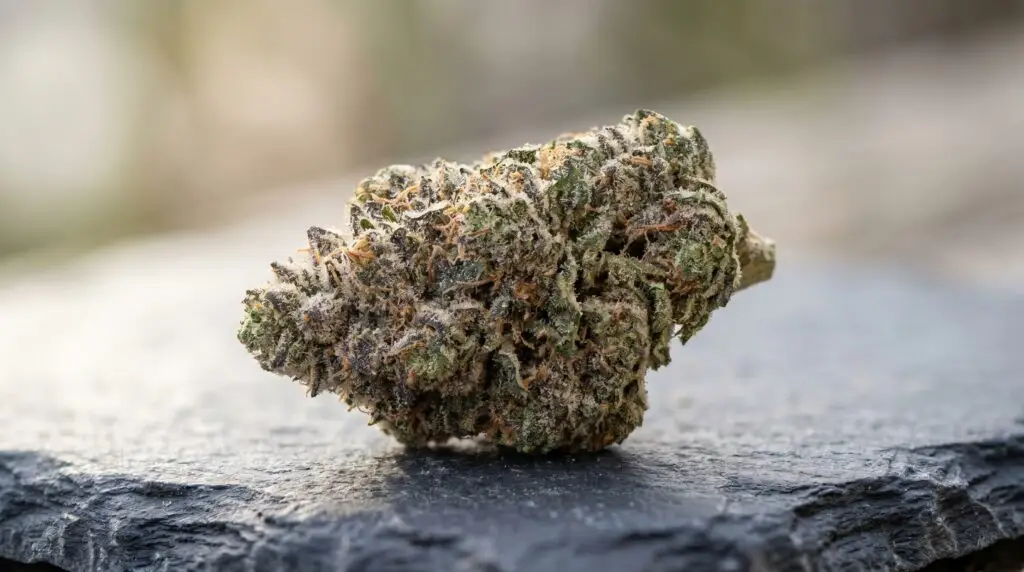
Most cannabis flower in Massachusetts dispensaries today is THC-dominant — typically 18% to 30% THC with trace CBD. CBD-dominant or balanced (1:1, 2:1) products are a smaller segment but well-stocked at most adult-use retailers.
That’s the foundation. Now the four worth knowing once you’ve found your THC comfort zone.
The clearer-headed cannabinoid
THCV stands for tetrahydrocannabivarin. Chemically, it looks a lot like THC — same molecular family, slightly shorter side-chain. The shorter side-chain is what makes it interesting: at low doses, THCV is essentially non-intoxicating, and at higher doses it produces a milder, often described as “clearer” or “more energetic” effect than THC.
Most strains contain only trace amounts of THCV (under 1%), which is why it’s a niche cannabinoid. Where it shows up in higher concentrations is in African landrace sativas — Durban Poison is the classic example — and some modern hybrids bred specifically for THCV expression.
What users commonly report with THCV-elevated products: a clearer head than equivalent THC doses, more energy and less couch-lock, and sometimes reduced appetite (less of a “munchies” effect).
A note: you’ll see marketing for THCV as “the diet cannabinoid” because of the appetite-suppressant claim. The clinical research is preliminary and we won’t make medical claims about it. What we can say is that experienced cannabis users frequently describe THCV-leaning sessions as feeling distinct from regular THC sessions — and that’s worth knowing if you’re someone who wants the social side of cannabis without the cognitive haze.
What aged THC turns into
CBN stands for cannabinol. It’s not actually produced by the cannabis plant in any meaningful quantity — it’s what THC turns into as it ages and oxidizes. Old, sun-exposed flower will have a higher CBN content than fresh flower.
CBN is mildly intoxicating, but only mildly. The dose required to produce a noticeable head change is much higher than THC. At typical product doses (a few milligrams), most users report a heavy, relaxed body feel rather than the cognitive shift THC produces.
You’ll see CBN most often in “nighttime” or “evening” gummies that combine 5–10 mg of THC with 2–5 mg of CBN. Early research is exploring CBN’s role in sedation, but the studies are small and we’re not going to overpromise — what we can tell you is that a lot of regular customers reach for CBN-blend products specifically when they want a body-heavy, low-cognitive evening experience.
If you’re new to cannabis and curious about CBN, look for a 5 mg THC + 2 mg CBN gummy and treat it as you would any low-dose edible — start there, wait 90 minutes, and let your body tell you if you want more.
The mother cannabinoid
CBG stands for cannabigerol, and it’s called the “mother cannabinoid” because every other cannabinoid in the plant starts as CBGA (the acidic form of CBG) before enzymatic processes convert it into THCA, CBDA, and the rest. By the time most flower is harvested, almost all of the original CBGA has converted into other cannabinoids — which is why CBG content in finished flower is usually under 1%.
A small but growing category of products is CBG-dominant — tinctures, gummies, and full-spectrum products bred or extracted to preserve CBG levels. CBG is non-intoxicating. Users describe the effect as mellow and “balancing” — often choosing it during the day, paired with a small amount of THC, for a steady baseline that doesn’t impair function.
Like CBN, the formal research on CBG is preliminary. The honest description: it’s a non-intoxicating cannabinoid that some users find pleasant and worth experimenting with. Don’t expect a head change. Do expect a subtle baseline shift.
What the label is mostly counting
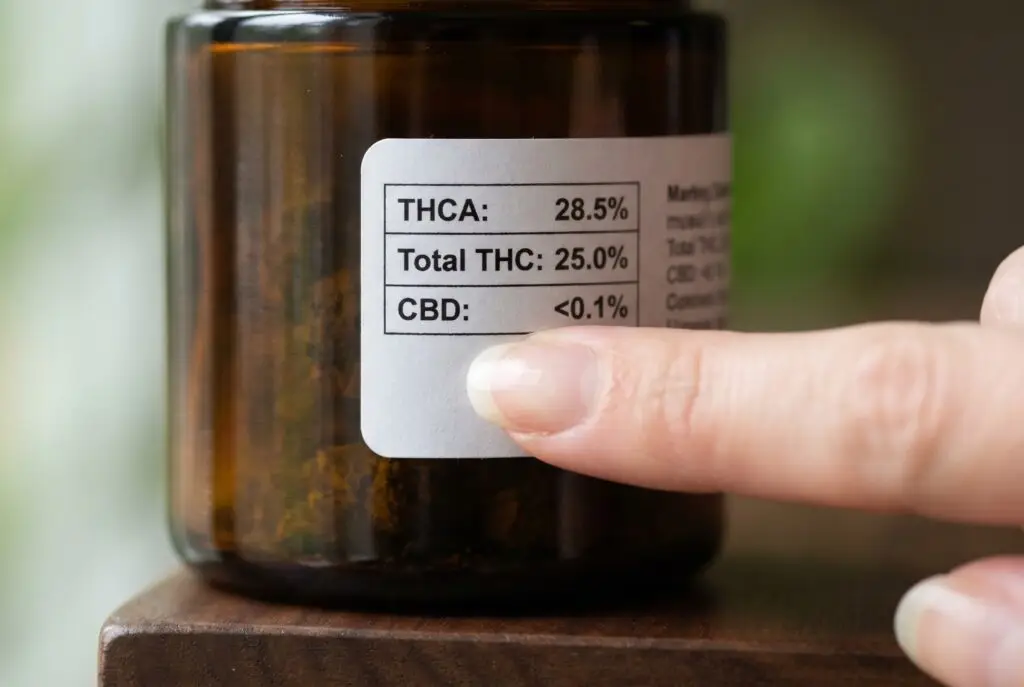
If you’ve ever picked up a flower jar and seen something like “THCA: 22% / Total THC: 19.3%,” THCA is what most of your “THC” actually is in fresh flower.
THCA stands for tetrahydrocannabinolic acid. It’s the raw, non-intoxicating form of THC produced by the cannabis plant. THCA only converts to THC when it’s heated — that conversion process is called decarboxylation (or “decarb” for short). Lighting a joint, hitting a vape, or baking flower into edibles all decarboxylate the THCA into active THC.
This is why fresh flower contains tiny amounts of actual THC and large amounts of THCA. The “Total THC” line on your label is calculated from the THCA content (multiplied by ~0.877, the conversion rate that accounts for the molecular weight loss when THCA loses its acid group during heating).
Practical takeaway: you don’t need to memorize the math. The dispensary’s lab labels do it for you. But knowing THCA exists explains why fresh flower potency math sometimes looks confusing — and why eating raw flower (not heated) won’t do anything; it has to be decarbed first.
What's actually legal in Massachusetts
You’ve probably seen Delta-8 THC at gas stations and smoke shops, sold as a “legal” alternative to regular cannabis. The product category is real. The legal story is more complicated, especially in Massachusetts.
Delta-9
The standard intoxicating cannabinoid in cannabis. Whenever a Massachusetts dispensary label says “THC,” it means Delta-9.
Delta-8
A chemical isomer of Delta-9 — same atoms, slightly different arrangement. Most users describe it as a milder, smoother version, with about 60–70% of the potency.
In Massachusetts
MA regulates Delta-8 the same way as Delta-9. Legal Delta-8 only comes from licensed dispensaries — not the gas-station hemp loophole.
What that means for shopping in Holyoke: any Delta-8 you find at Holyoke Cannabis is legal, lab-tested, and tracked through the same Metrc system as all other regulated cannabis. Anything labeled “Delta-8” at a non-licensed shop is operating in a gray area we’d recommend avoiding.
CBC, CBDV, terpenes — and the entourage effect
Beyond the six above, you’ll occasionally see CBC (cannabichromene) and CBDV (cannabidivarin) on full-spectrum tincture labels. Both are non-intoxicating, both appear in trace amounts in most flower, and both are areas of active early-stage research. You don’t need to chase them — but they contribute to the entourage effect: the idea that cannabis works as a system of compounds, not just THC and CBD.
Speaking of the entourage effect: the other half of that system is terpenes. Terpenes are the aromatic compounds responsible for cannabis flavors and smells — pine, citrus, diesel, berry. They aren’t cannabinoids, but they interact with cannabinoid receptors and can shift the character of a high. Strains heavy in myrcene (mango, earthy) tend to feel sedating; strains heavy in limonene (citrus) tend to feel uplifting. The terpene profile on your label is worth a glance, even when the cannabinoid percentages look identical between two strains.
How to read a Massachusetts label
Every product sold at a licensed Massachusetts dispensary carries a lab-tested cannabinoid panel. Here’s what to look for:
| Label line | What it means |
|---|---|
| Total THC | Active THC after decarboxylation — what you’ll actually feel |
| THCA | Raw, pre-heated THC — most of the “THC” in fresh flower |
| Total CBD | Active CBD content |
| CBDA | Raw, pre-heated CBD |
| Other cannabinoids | THCV, CBN, CBG, CBC, CBDV — listed if present at meaningful levels |
| Terpenes | Often listed by dominant terpene (myrcene, limonene, pinene, etc.) |
| Tested by | Massachusetts-licensed independent testing lab |
| Batch / harvest date | Use this to gauge freshness — within 6–12 months is ideal |
If a product doesn’t list these — or lists them on a sticker that looks aftermarket — it isn’t from a licensed Massachusetts retailer. Walk away.
Find these cannabinoids on Holyoke's menu
- Curious about THCV — filter to sativa flower; look for Durban Poison, Doug's Varin, or strains noted with THCV content above 1%
- Looking for CBN — filter to gummies and tinctures, look for “nighttime” or “PM” formulations
- Trying CBG — filter to tinctures and full-spectrum products; CBG-dominant edibles are a smaller category
- Want a CBD-leaning experience — filter to 1:1 or CBD-dominant products in any category
If you’re not sure where to start, our team runs the floor every day and knows which products our regulars come back for. Stop by, ask, and we’ll point you at something that fits where you are.
Frequently asked questions
Is THCV legal in Massachusetts?
Will CBN make me high?
What's the difference between Delta-8 and Delta-9 THC?
Is hemp-derived Delta-8 from a gas station the same as dispensary Delta-8?
My label says “THCA: 22%” but “Total THC: 19.3%” — which is the real number?
Can a single strain be high in both THC and THCV?
What's the entourage effect?
How do I know which cannabinoids work for me without buying everything?
Premium cannabis. Expert guidance. Friendly faces.
If you want to try a cannabinoid you’ve never had — THCV-elevated flower, a CBN nighttime gummy, a CBG tincture — our team will walk you through what’s on the shelf and help you pick a starting dose. Bring a valid 21+ ID. We’ll handle the rest.